How architects, designers, and homeowners are dissolving the boundary between the bath and the open air — and why it might be the most sensual design decision you ever make
There's a moment that happens in the best-designed bathrooms — a stillness that's hard to articulate until you've felt it. You're standing at a stone basin, morning light coming in low, and the air smells like wet garden, like the world just woke up alongside you. The tile beneath your feet is cool. Through a frameless glass panel or a pivot door left open, you can see the sky.
This is the indoor-outdoor bathroom. Not a trend, exactly. More like a reckoning.
For decades, the bathroom was the most closed-off room in the house — its design governed by privacy, plumbing constraints, and a deep cultural conviction that the body's rituals should happen behind the thickest walls possible. That's changing. And it's changing fast, driven by a convergence of architectural innovation, a post-pandemic hunger for openness, and a fundamental rethinking of what "sanctuary" actually means.
What Indoor-Outdoor Flow Really Means
Let's be precise here, because the term gets used loosely. Indoor-outdoor bathroom flow isn't about cutting a window in a wall and calling it a day. It's the intentional design of a continuous spatial experience — where the bathroom doesn't end at a threshold but bleeds, architecturally and atmospherically, into the exterior environment.
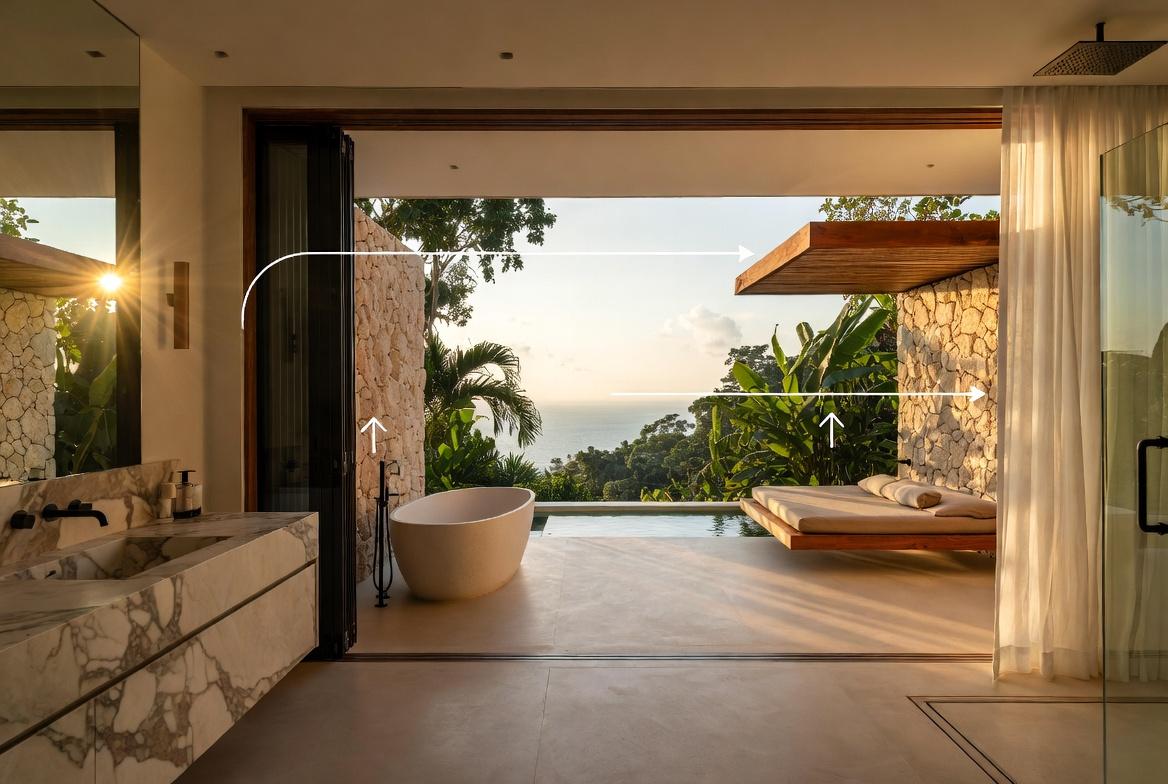
In practice, this shows up in a range of configurations. A shower that opens onto a private garden courtyard. A freestanding soaking tub positioned to extend visually into a landscaped terrace. A vanity wall that dissolves into a wall of folding glass, turning the entire morning routine into a relationship with the outside world.
The key word is continuity. Materials flow from inside to outside — the same travertine on the bathroom floor continues as a deck surface. The ceiling plane extends outward as a covered pergola. The lighting is designed as a unified scheme across both zones. These spaces aren't simply rooms with nice views. They're environments that refuse to acknowledge the division between shelter and landscape.
The Architecture of Openness
The technical achievement that makes indoor-outdoor bathrooms possible at scale is largely a story about glass. Specifically, the explosion of large-format frameless glazing systems, pivot doors, and folding wall systems that can span full room widths without the visual interruption of traditional frames.
Architects working in this mode are reaching for what theorists call "the dissolving threshold" — the point at which a visitor to the space cannot quite identify where interior becomes exterior. This requires careful orchestration of several variables simultaneously.
Floor planes have to be considered first. The transition from interior tile to exterior decking is historically a visual and tactile interruption, with a threshold strip, a level change, and a material shift that announces: you are crossing a boundary. In high-end indoor-outdoor bathroom design, this transition is either eliminated entirely (using continuous stone that tolerates both conditions) or made so subtle — a barely-there linear drain, a flush deck surface — that it registers subconsciously rather than consciously.
Ceiling and overhead structure come next. An interior bathroom ceiling that stops abruptly at a glass wall makes the interior feel capped and contained, however big the view. When the ceiling plane extends — as a deep overhang, a pergola continuation, or a cantilevered concrete soffit — the eye follows it outward, and the sense of enclosure expands to include the outdoor zone.
Light management is the third pillar. Natural light is the whole point, but it must be handled intelligently. Morning sun that floods an east-facing outdoor shower is exactly right. Midday sun that turns a west-facing tub surround into a heat trap is a design failure. The best indoor-outdoor bathrooms are conceived with solar orientation as a primary variable — not an afterthought.
Why This Matters Psychologically
Design decisions aren't just aesthetic. They do things to people.
Research in environmental psychology has consistently found that access to natural light and natural views reduces stress hormone production, improves mood, and shortens perceived recovery time — which is why hospitals have invested heavily in window access for patient rooms. The bathroom, arguably the most intimate and restorative space in the domestic environment, is a logical beneficiary of these findings.
But the indoor-outdoor bathroom offers something more specific than mere window access. It offers what psychologists call prospect — the experience of being able to see widely, to survey an expansive view — combined with refuge, the sense of being safely enclosed. This combination, prospect and refuge, is among the most emotionally satisfying spatial configurations a human being can occupy. It's the same reason people choose corner tables in restaurants, window seats on trains, terraced hillside houses over flat suburban lots.
A bathroom designed around indoor-outdoor flow provides both simultaneously. You are in the intimate enclosure of a tub or shower; you are also looking out at open sky, garden, water, landscape. The nervous system finds this deeply coherent. It is not accidental that high-end wellness retreats and destination spas have understood this for decades.
The Design Vocabulary — Key Elements and How They Work
The Pivot Door and the Folding Glass Wall
These are the workhorses of indoor-outdoor bathrooms. Pivot doors — oversized single panels that rotate on a central or offset axis — create a dramatic opening gesture that frameless sliding or swinging doors can't match. A full-height pivot door in dark-patinated steel with reeded glass feels like architecture, not just hardware. It makes the act of opening the bathroom to the outside into something ceremonial.
Folding glass wall systems (often called NanaWalls, after a major manufacturer, though the category is broader) allow an entire wall to accordion open, collapsing the distinction between inside and outside entirely. They're particularly powerful in wet rooms and outdoor shower configurations where you want the shower itself to be in dialogue with a garden.
Material Continuity
The selection of materials that can perform in both interior and exterior contexts is both a constraint and a creative opportunity. Not every beautiful tile is rated for outdoor use. Stone that looks stunning on a bathroom floor may not survive freeze-thaw cycles in cold climates. The design discipline required here often produces more interesting results than unconstrained material choices — because the designer is forced toward materials with genuine substance.
Natural stone — limestone, travertine, slate, bluestone — is the classic answer, and for good reason. It handles water, tolerates temperature variation, and develops character with age rather than deteriorating in the way many manufactured surfaces do. Large-format porcelain rated for exterior use is the more accessible alternative, and contemporary manufacturing has produced panels with the visual depth and variation of natural stone at a significantly lower price point.
Teak and other hardwoods with natural water resistance bring warmth to wet environments and bridge the visual gap between the organic exterior (garden, landscape) and the more architectural interior. A teak soaking tub surround or shower deck that continues as a deck surface outside is among the most visually satisfying material transitions in this typology.
Drainage and Weather Management
This is where indoor-outdoor bathroom design gets practical in a hurry. The outdoor zone must drain effectively. Wind-driven rain can reach further than you think into a covered outdoor shower. The interface between the indoor wet room and the outdoor zone needs to be engineered so that water moves in one direction (out) under all conditions.
Linear drains positioned at the indoor-outdoor threshold are a reliable solution, functioning as both a drainage channel and a visual datum that marks the transition zone without disrupting material continuity. Sloped floor planes that guide water toward exterior drains are essential in any outdoor shower configuration.
Climate Considerations — This Isn't Just for the Tropics
There's a persistent assumption that indoor-outdoor bathrooms are exclusively appropriate in warm, dry, or tropical climates — the Bali villa, the Palm Springs retreat, the Mediterranean terrace house. This assumption is worth examining, and largely dismantling.
In temperate and even cold climates, the indoor-outdoor bathroom can be designed for seasonal engagement rather than year-round openness. A bathroom designed with a large frameless glass wall looking onto a snow-covered garden is still an indoor-outdoor bathroom — the view, the light, the connection to the exterior environment are all present, even when the glass remains closed for eight months of the year. The design intention is what counts.
More interesting, perhaps, is the approach taken by Scandinavian designers working in genuinely cold climates: the outdoor component becomes the thing you choose. An outdoor shower used in summer, a wood-fired hot tub accessible from the bathroom in winter, a sauna transition from interior bath to exterior cold plunge — these are not compromises. They're the point.
The cold-climate outdoor bathroom also engages with landscape in a way that warmer configurations don't — frost on glass, bare branches, the particular quality of winter light through a north-facing window. These are not deprivations. They are a kind of beauty that the sealed, windowless bathroom entirely forecloses.
Privacy Without Walls
The question everyone asks about the indoor-outdoor bathroom is also the most obvious one: what about privacy?
It's a reasonable concern, but it's often asked as though privacy is binary — either you have it or you don't — when in fact it's spatial, directional, and highly designable.
Privacy in indoor-outdoor bathrooms is almost always solved through screening strategy rather than solid enclosure. The outdoor zone of an indoor-outdoor bathroom is typically a controlled aperture — a courtyard, a walled garden, a screened terrace — rather than a direct opening to the street or a neighbor's sight line. The view is curated: you're looking at sky, at planting, at water, at a landscape composition the designer has assembled precisely because you will be looking at it in states of undress and vulnerability.
Specific approaches include:
The courtyard model — a private enclosed garden, entirely surrounded by walls or planting, accessible from the bathroom. This is the most common approach in urban and suburban settings and provides complete privacy while maintaining full outdoor access. The best courtyard bathrooms treat the garden as a room within a room: planted, lit, drained, and furnished as deliberately as the interior.
Planting screens — mature bamboo, hornbeam hedges, espalier fruit trees, or dense evergreen planting establish visual barriers without the weight of masonry. They have the advantage of filtering light and moving in wind, bringing the exterior space alive in a way walls cannot.
Strategic orientation — simply pointing the opening away from any possible sight line. Toward the sky. Toward a boundary wall. Into a corner. Geometry is free.
Louvered screens and slatted timber — fixed or operable louvered panels in timber or aluminum allow air and light to pass while blocking direct views. They're particularly effective on upper stories where overlooking from neighboring properties is the primary concern.
Comparison — Key Indoor-Outdoor Bathroom Configurations
Different approaches to this design typology suit different sites, budgets, climates, and lifestyles. Here's a clear-eyed comparison:
| Configuration | Privacy Level | Cost Range | Best Climate | Maintenance | Wow Factor |
|---|---|---|---|---|---|
| Courtyard garden bath | Very high — fully enclosed | High | All climates | Medium — garden upkeep | Exceptional |
| Folding glass wall to terrace | Medium — depends on screen strategy | Very high | Warm/temperate | Low-medium | Very high |
| Outdoor shower attached to bathroom | Medium-high with screening | Medium | Warm/temperate | Low | High |
| Floor-to-ceiling glazed wall (fixed) | High — view only, no opening | Medium | All climates | Low | High |
| Pivot door to walled outdoor shower | High | Medium-high | Warm/tropical | Low | High |
| Rooftop bath with skyline/landscape view | Very high — elevated position | Very high | All climates | Medium | Exceptional |
| Sauna to outdoor cold plunge | Medium — enclosed sauna | Medium | Cold/temperate | Medium | Very high |
| Bath platform cantilevered over landscape | Low without screens | Very high | Warm/dry | Low | Extraordinary |
The courtyard model is the most universally applicable and offers the highest privacy, but it requires ground-level space and a meaningful garden investment. The folding glass wall to terrace is architecturally spectacular but demands careful weather and privacy engineering to succeed. The simplest intervention — an outdoor shower connected to an interior bathroom — provides a high return on investment for relatively modest cost, particularly when integrated into an existing renovation.
Landscape as the Fifth Wall
Architects conventionally speak of the bathroom's "four walls and a ceiling." In the indoor-outdoor bathroom, the landscape becomes the fifth wall — not as metaphor but as literal design element.
This is where the interior designer's remit expands into territory traditionally occupied by the landscape architect. The planting visible from a soaking tub is not incidental; it's part of the room. The choice between clipped hedges (structured, quiet, formal) and naturalistic meadow planting (loose, seasonal, alive with movement) is as significant as the choice of tile.
Water features in the outdoor zone of a bathroom are among the most powerful moves available. A reflecting pool that extends the visual plane of the bathroom floor into the exterior space creates an almost hallucinatory sense of depth and calm. The sound of moving water — a narrow rill, a simple weir — overlaps with and transforms the acoustic character of the interior.
Lighting in the outdoor zone deserves equal design attention. Uplighting through planting, low-level path markers, underwater pool lighting, and the careful placement of lanterns or fire elements all extend the usability and atmosphere of the outdoor zone into the evening — which, for soaking tubs and freestanding baths, is exactly when you want to be using them.
The Sustainability Argument
Beyond aesthetics and wellbeing, there's an environmental case for indoor-outdoor bathroom design that doesn't get made often enough.
Spaces designed around natural light reduce artificial lighting loads. Cross-ventilation through an open outdoor connection dramatically reduces mechanical dehumidification requirements in bathrooms — one of the primary energy uses in sealed, ventilated bathroom design. An outdoor shower fed by a solar hot water system reduces energy demand substantially.
There's also a relationship to water. Outdoor shower zones can be designed to drain to landscape, contributing to garden irrigation rather than the municipal stormwater system. Greywater systems that use bathroom water for garden irrigation are more practical in indoor-outdoor configurations where the exterior zone is already plumbed and landscaped.
None of this makes indoor-outdoor bathroom design inherently green — a heated outdoor soaking tub with a sophisticated filtration system carries its own carbon footprint. But the design ethos, at its best, is one of working with natural systems rather than against them, and that alignment tends to produce more sustainable outcomes than design that treats the environment as backdrop.
Where This Is Going
The trajectory here is clear. As residential architecture increasingly responds to a population that emerged from lockdown years with a recalibrated relationship to indoor space — and to the outdoors — the indoor-outdoor bathroom will move from luxury exception to design standard.
We're already seeing it in planning: new residential developments in warm-climate cities routinely include private courtyard bathrooms in apartment configurations, not just in single-family homes. The technology — the glazing systems, the drainage engineering, the weatherproof materials — is increasingly accessible. The design language is becoming shared enough that clients can communicate what they want and find contractors who know how to deliver it.
What won't change is the fundamental reason this design typology exists and endures. The bathroom is where the day begins and ends. It's where the body is attended to, the mind is quieted, the transition between private and public self is managed. To do all of that in dialogue with open sky and living landscape, rather than inside a sealed box of tile and plasterboard, is not indulgence. It's just paying attention to what actually sustains human beings.
The wall didn't disappear because someone thought it would look good in a magazine. It disappeared because, once it was gone, everyone wondered why it had been there in the first place.
The indoor-outdoor bathroom sits at the intersection of architecture, landscape design, environmental psychology, and a very old human instinct: the desire to be simultaneously protected and open to the world. Get the balance right, and it becomes the best room in the house.