Infinity and vanishing-edge pools are among the most technically demanding feats in residential architecture — and the most psychologically potent. Understanding why they work means standing at the edge of physics, optics, and desire.
There is a precise moment, usually around dusk, when a well-designed infinity pool stops being a swimming pool and becomes something else entirely. The water flattens. The sky drops. The edge dissolves. For one suspended second, the eye cannot find the line where the basin ends and the view continues — and the brain, uncertain, simply lets it go.
That moment is not accidental. It is engineered.
Infinity pools — also called vanishing-edge, negative-edge, or zero-edge pools — are one of the most technically exacting products in residential architecture. They cost more to build, more to maintain, and far more to get right. Their failure modes are subtle but ruinous. Their success, when it arrives, is among the most striking things a built structure can achieve.
This is the full story of how they work, what separates a good one from a great one, and everything a prospective owner needs to understand before a single hole is dug.
The Optical Trick at the Heart of It
To understand an infinity pool, start with the eye and work backwards.
A conventional swimming pool is a container. Its walls are visible. Its edges are defined. From the deck, you see pool, then coping, then yard, then whatever lies beyond. The visual hierarchy is clear: water is contained, and the container has a boundary.
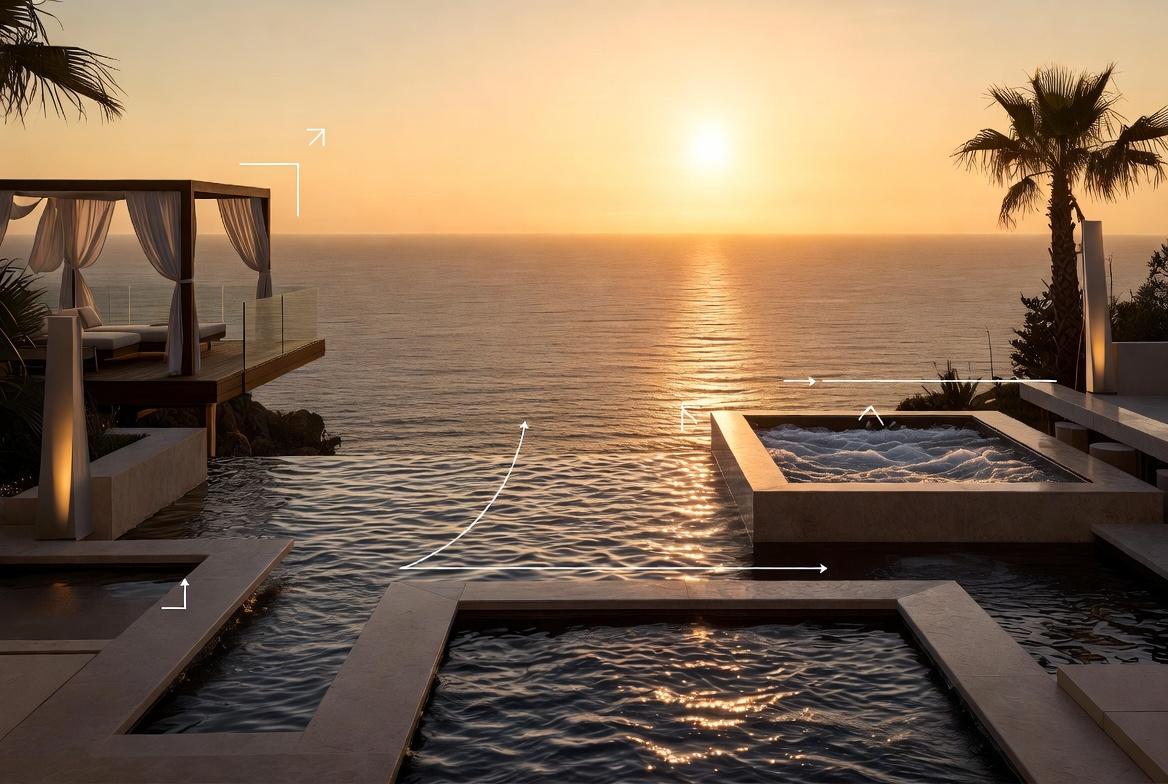
An infinity pool removes one or more of those boundaries from the viewer's sightline. On the vanishing edge — typically the side facing the most dramatic view — the pool wall is lowered to a precise height so that the waterline sits level with, or fractionally above, the pool deck. Water spills continuously over this edge in a thin, even sheet, falling into a concealed catch basin below. From the swimmer's vantage point inside the pool, that edge disappears. The water appears to extend outward, meeting the horizon — a lake, an ocean, a valley, or simply the sky.
The illusion depends entirely on line-of-sight alignment. The edge must be calibrated to the primary viewing angle — most often from the water itself, at shoulder height, looking toward the feature view. Design the edge for a lounger instead and the whole thing reads wrong. It is the first constraint that defines everything downstream.
A Brief and Surprisingly Old History
The vanishing edge is not a product of the Instagram age, though it found its broadest audience there. Overflow water features have existed in formal garden design for centuries — the water channels of the Alhambra in Granada produce a mild version of the effect, as do the mirror pools of the Taj Mahal complex. The eye of 16th-century garden designers understood, if intuitively, that water flush with its surround reads as infinite.
The modern infinity pool as a residential typology emerged in earnest through French architect Alain Domingo and his work in the South of France in the 1990s, though the form was being explored simultaneously in several traditions. What changed was the building technology: gunite construction allowed pool shells to hold complex geometries at the precision tolerances the vanishing edge demands. Automated balance tank systems removed the engineering burden that had previously made maintenance a near-professional undertaking.
By the early 2000s, the typology had migrated from French hillsides and Balinese resort architecture into the vocabulary of high-end residential design worldwide. By the 2010s, rooftop infinity pools were being commissioned on urban towers. The Marina Bay Sands pool in Singapore — occupying the 57th-floor "SkyPark" cantilevered over the bay — became the form's most-photographed expression, a kind of shorthand for luxury without horizon.
The Engineering Underneath the Beauty
Strip the poetry away and an infinity pool is, at its core, a hydraulic system with unusually demanding tolerances. Three subsystems must work in concert: the main pool basin, the catch basin, and the recirculation system that connects them.
The vanishing edge wall
The edge wall — the structural element over which water spills — is the single most critical component in the build. It must be level to within two to three millimetres across its entire length. On a twelve-metre pool, that is an extraordinarily tight specification. Any deviation and the overflow sheet will be uneven: water will pile up on one side, skip on the other, and the illusion collapses into a plumbing problem visible to anyone standing nearby.
The edge is typically built in bond beam concrete or cast stone and finished in a material chosen for its interaction with thin water sheets — polished stone or glass tile being most common. The material must be non-porous enough to resist the mineral deposits that form wherever moving water contacts a surface repeatedly.
The catch basin
Below the vanishing edge, hidden from view, sits the catch basin: a secondary pool that receives the overflow and holds it until the recirculation pumps return it to the main pool. The catch basin must be sized to accommodate two variables that pull against each other: bather displacement and evaporation.
When swimmers enter the main pool, displaced water increases overflow volume dramatically. When the pool empties of people, overflow slows to a trickle. The catch basin must be large enough to absorb peak displacement without backing up and flooding the edge — which would destroy the illusion — but not so large that it becomes an expensive void in the hillside. Professional sizing calculations depend on maximum bather load, the area of the vanishing edge, and local evaporation rates.
The recirculation system
Water lost over the edge is water that must be returned. The pump system feeding from the catch basin back to the main pool must move water faster than it overflows, continuously, around the clock. This means larger pumps than a conventional pool of equivalent volume, higher operating costs, and a system that — if it fails — will drain both the catch basin and, eventually, the main pool as water continues to spill with nowhere to go.
Automation handles the balance tank level monitoring in all contemporary installations. Sensors in the catch basin trigger pump activation when the level rises above a threshold and cut power when it drops, preventing dry-run pump damage. On premium builds, these systems are integrated into the building management system and can trigger alerts remotely.
A common installation failure: the catch basin is undersized for the site's wind conditions. On exposed hillside sites, wind can push water toward the vanishing edge continuously, accelerating overflow beyond what the basin and pumps can handle. Site-specific wind studies are not optional on exposed installations.
Infinity vs. Vanishing Edge: Are They the Same?
The terms are used interchangeably in residential sales contexts, but they describe slightly different configurations. The distinction matters more to engineers than to owners, but it surfaces often enough in specifications to be worth clarifying.
A vanishing-edge pool has one edge that overflows — the featured edge, designed to face a specific view. The remaining three sides are conventional, with visible coping. This is the most common residential typology because it is the most manageable: only one overflow system, one catch basin, one primary maintenance circuit.
An infinity pool, strictly speaking, has overflow on multiple edges — potentially all four, creating the impression of a water surface with no visible boundary from any direction. This configuration is geometrically dramatic but mechanically complex: catch basins must be positioned on multiple sides, recirculation loads multiply, and levelling tolerances must be met on every edge simultaneously. True four-edge infinity pools are rare outside of resort and commercial contexts precisely because the engineering and maintenance demands compound significantly with each additional overflow edge.
The zero-edge pool is a third variant, less discussed: a pool in which the water surface is flush with the surrounding deck on all sides, with no overflow sheet. Water is controlled at the edge through precision overflow channels rather than a visible sheet effect. The result is more subtle — almost invisible at deck level — and is often chosen for contemporary architectural contexts where the sheet-overflow aesthetic reads as too theatrical.
"The illusion asks the eye to suspend its understanding of physics. The engineering's job is to make that suspension effortless."
The Full Comparison: Infinity, Vanishing-Edge, and Standard Pools
| Feature | Standard Pool | Vanishing-Edge | True Infinity (Multi-edge) |
|---|---|---|---|
| Overflow edges | None | One (featured side) | Two to four |
| Catch basin required | No | Yes — one | Yes — multiple |
| Levelling tolerance | Standard (±10mm) | Tight (±3mm on edge) | Very tight (±2mm, all edges) |
| Construction cost premium | Baseline | 30–80% above baseline | 80–200%+ above baseline |
| Site requirement | Flat or gently sloped | Slope or drop preferred | Multi-aspect elevation needed |
| Running cost vs. standard | Baseline | 15–30% higher | 40–80% higher |
| Visual drama from water | Low | High (one axis) | Very high (all axes) |
| Maintenance complexity | Low | Moderate | High |
| Automation dependency | Optional | Recommended | Essential |
| Suitable for urban rooftop | Yes | With engineering | Rarely practical |
| Illusion works from poolside | No | Yes (one direction) | Yes (all directions) |
| Illusion works from inside pool | No | Yes (primary view) | Yes (360°) |
Site Selection: Where the Design Either Works or Doesn't
No single factor determines the success of an infinity pool installation more than its site. The effect requires a view — not merely open sky, but a view with a legible horizon or a visual plane that the eye can read as a continuation of the water surface. A pool positioned against a fence, a neighbouring building, or a flat lawn achieves very little of the intended effect regardless of how precisely the edge is built.
The ideal site has elevation change. A pool positioned at the top of a natural slope, with the vanishing edge facing the drop, allows the catch basin to be constructed below grade and out of view. The overflow sheet falls into space rather than onto a visible surface, deepening the illusion. The view beyond — a valley, a body of water, a distant city — provides the visual anchor that the eye uses as a "horizon".
In flat-site installations, this natural geometry must be manufactured. The pool can be elevated on a raised structural deck, with the catch basin built into the structure below. These "elevated deck" installations are common in urban and suburban contexts but add significantly to structural engineering costs and require careful integration with surrounding landscape grades to avoid the pool appearing marooned on a plinth.
The orientation question
Once a site is selected, the orientation of the vanishing edge relative to the view and the sun requires careful study. An east-facing vanishing edge will catch morning light across the overflow sheet; west-facing edges glow at dusk. Both can be beautiful. But a vanishing edge facing directly into the midday sun will cause glare across the water surface that overwhelms the effect entirely. The designer must work with solar path diagrams to identify the primary viewing window and orient accordingly.
Materials and Finish: The Surface Changes Everything
The visual character of an infinity pool is determined as much by its interior finish as by its configuration. Water is essentially colourless; what a swimmer sees looking down into the basin is the finish reflecting and refracting light. The finish colour determines whether the water reads as tropical green, Caribbean blue, midnight black, or a near-mirror grey.
On a vanishing-edge pool, the finish choice also affects how the overflow sheet reads. A light-coloured finish makes the sheet more visible — you can see the thin veil of water against the dark background beyond. A dark finish causes the sheet to near-disappear, intensifying the edge illusion but reducing the ornamental drama of the overflow itself. Neither is correct; they produce different effects and should be selected in conversation with the surrounding landscape palette.
The Maintenance Reality
This is where enthusiasm must give way to candour. Infinity pools are not low-maintenance structures. Their appeal, which rests on an impression of effortlessness, belies a hydraulic system that requires consistent, informed attention.
The catch basin is the primary maintenance site. Because all pool water cycles through the catch basin before returning to the main pool, chemical balance fluctuations concentrate there. Algae, mineral deposits, and biological growth can establish in the catch basin before being circulated back into the main pool. Professional pool operators typically inspect the catch basin every one to two weeks.
The overflow edge itself accumulates calcium carbonate and mineral scale at the point where the water sheet forms and evaporates. This "tide mark" is cosmetically conspicuous on polished surfaces and requires periodic acid washing to remove. The frequency depends on water hardness and climate — in hard-water regions with high evaporation rates, scale can form visibly within weeks.
Winter closure requires particular care. On sites where temperatures drop below freezing, water must be drained from both the main pool and catch basin to prevent freeze-expansion damage to the shell and particularly to the precision-set overflow edge. Even minor frost damage to the edge coping can shift the levelling by enough to disrupt the overflow sheet pattern and require costly re-setting the following season.
The most expensive mistake in infinity pool maintenance is allowing the catch basin to run dry due to pump failure or sensor error while the overflow continues. A dry-run pump can fail within minutes. The return to normal operation then requires manual re-priming — and if the main pool has also drained significantly, refilling both basins resets the chemical balance from zero.
Cost: What the Market Actually Charges
Any cost figure quoted for an infinity pool installation must be understood as highly site-specific. That caveat established, the market reality is clear: the vanishing-edge premium over a comparable conventional pool typically runs between 30 and 80 percent for a single-edge installation, with costs scaling steeply for multi-edge configurations, difficult sites, or premium finish specifications.
The premium breaks down across several line items. The structural catch basin — including excavation, concrete work, and waterproofing — adds cost that has no equivalent in a standard build. The precision levelling of the overflow edge requires specialist labour and typically multiple adjustment cycles during construction. The enhanced pump and automation system runs higher than a standard recirculation package. And the finish on the overflow edge itself — often polished stone or glass tile that will be in constant contact with moving water — specifies at a higher grade than typical interior pool finish.
Operating costs follow the same pattern. Larger pumps moving larger water volumes continuously consume more electricity than a standard filtration circuit. Chemical usage increases because the catch basin introduces a second evaporation surface and a secondary chemical contact point. And professional maintenance visits, while similar in frequency to a well-run standard pool, are more complex per visit.
None of this argues against the investment — it argues for entering it with accurate expectations. Owners who arrive at the decision fully briefed on the engineering and the lifetime cost tend to be satisfied buyers. Those who are sold primarily on the visual result sometimes discover, in the second or third season of operation, that the gap between the experience and the effort required to maintain it is wider than anticipated.
The Psychology of the Infinite Edge
Step back from the engineering for a moment and consider what the infinity pool actually does to its occupant.
Water, as a substance, has always held psychological weight in architecture. Its reflectivity creates a doubled world. Its movement invites attention. Its temperature contrast with air produces a heightened physical awareness. Swimming pools concentrate these effects in a controlled space: the swimmer exists in a pocket of heightened perception, cut off from the ordinary world by the simple act of submersion.
The vanishing edge extends this effect outward. By removing the visual boundary between pool and view, it places the swimmer at the apparent edge of the world. The psychological effect — described consistently by architects, landscape designers, and owners alike — is a kind of expansive calm. The enclosed anxiety of being in a box of water is replaced by the sensation of floating in open space. It is, in the most precise sense, a designed emotion.
This explains the form's hold on the luxury residential market better than any specification sheet. The infinity pool is not primarily a swimming facility. It is a room — a room made of water and light and the studied manipulation of what the eye can see — and its purpose is not exercise but experience.
That it also happens to be a formidable piece of hydraulic engineering is part of what makes it extraordinary. The emotion is real. The physics that produces it is just as real. And the craft required to make them coincide, night after night, season after season, without visible effort — that is what separates a good infinity pool from a merely expensive one.