The material that lines the shell of your pool determines not just how it looks — but how it feels underfoot, how it ages, how much work it demands of you, and the precise shade of blue that greets you every morning. This is a guide to choosing wisely.
There is a moment, usually sometime around the second or third year of owning a pool, when the finish stops being invisible. Maybe a rough patch has appeared near the steps. Perhaps the colour has shifted — faded to an odd grey where it once glowed sapphire. Or perhaps you are simply planning a new build and realising, for the first time, that the interior surface is neither a minor detail nor a decorative afterthought: it is the single material that defines the entire swimming experience.
Natural stone and pebble finishes occupy a particular place in the pool design world. They are not the cheapest option. They are not the quickest to install. But in the right circumstances — with the right water chemistry, the right design intent, and the right expectations — they deliver an aesthetic and textural quality that no painted plaster or synthetic product can convincingly replicate.
This guide examines the major stone and pebble finish types available today: what they are made of, how they perform over time, what they cost to install and maintain, and where each one genuinely excels. By the end, you should have a clear sense of which surface belongs in your pool — and, equally important, which ones do not.
Why Natural Surfaces Behave Differently
Before diving into specific materials, it is worth understanding what separates stone and pebble finishes from their synthetic counterparts in functional terms. The difference is not merely visual.
Natural stone and aggregate finishes are porous to varying degrees. That porosity affects water absorption, the likelihood of algae taking hold, the surface temperature on a hot day, and the way the finish interacts with pool chemicals over years of use. A dense, low-porosity stone like granite behaves almost like a ceramic in its resistance to staining and chemical attack. A more porous material like travertine, on the other hand, requires more attentive water chemistry management to prevent discolouration and surface degradation.
The other fundamental difference is texture. Natural pebble and aggregate finishes are, by definition, uneven at a micro level. Rounded river pebbles produce a surface that feels like walking on a smooth riverbed — comfortable barefoot after a brief period of adjustment. Exposed aggregate finishes with sharper profiles can be uncomfortable underfoot, particularly for children, if the aggregate has been selected without that consideration in mind.
Designer's Note
The water colour in a pool is not determined by the water itself — it is determined by the interior surface. A dark charcoal pebble finish produces dramatically different water tones than a white or cream surface, often rendering the pool a deep, tropical blue-green rather than the bright aquamarine associated with pale plasters. This effect is worth testing with physical samples before committing to a finish.
River Pebble: The Democratic Natural Finish
Of all the natural finishes, exposed river pebble — sold under trade names such as Pebblecrete, Pebble Tec, and various regional equivalents — is the most frequently specified in new residential pool builds. There are good reasons for this. It strikes a genuine balance between cost, longevity, aesthetic versatility, and installation practicality that few competing surfaces can match.
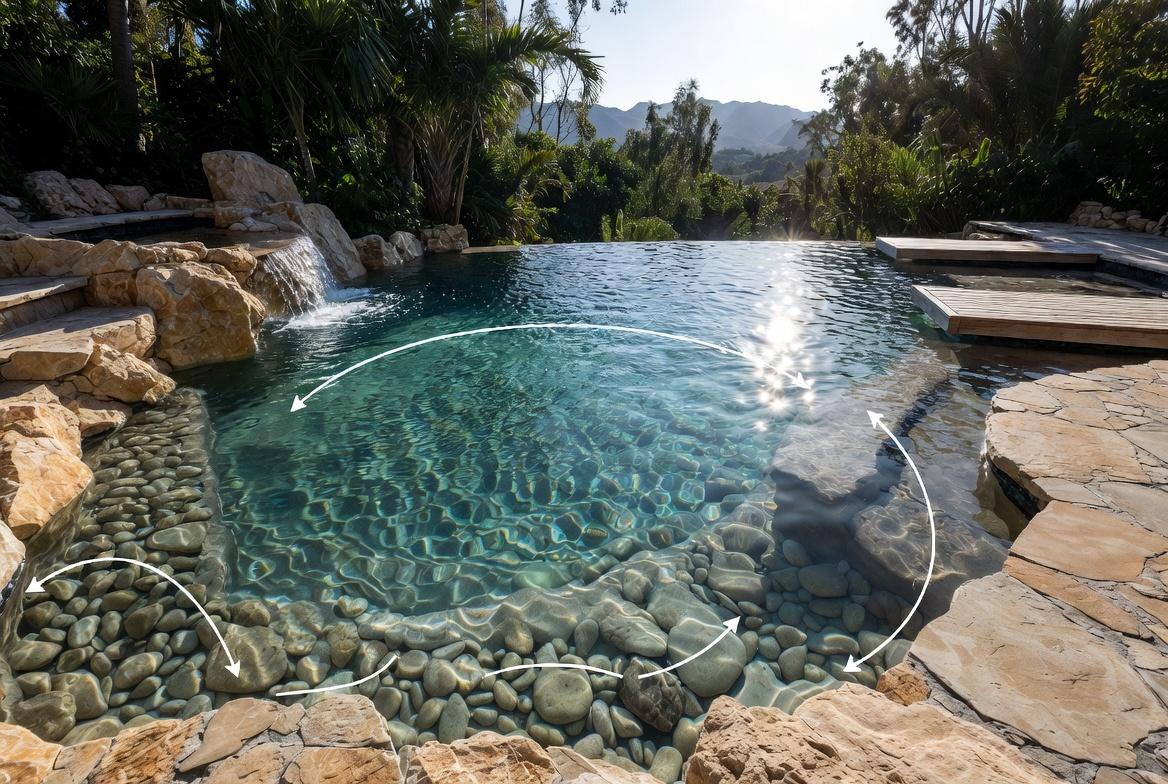
The finish is created by pressing small river pebbles into a cementitious base, then washing the surface before the cement fully cures to expose the rounded tops of the stones. The result is a natural-looking surface with a tactile quality entirely different from smooth plaster or tile: textured, slightly irregular, and pleasantly similar to a riverbed underfoot once the pebbles have been worn slightly smooth by foot traffic and water movement.
Colour choices are extensive. Pebbles are available in tones ranging from near-white quartz through tawny sandy shades, terracotta-inflected earth tones, and deep charcoals and blacks. The colour of the pebble determines the colour of the water, and this relationship deserves careful consideration. White or cream pebble palettes produce bright, clear aquamarine water resembling a Caribbean lagoon. Darker blends — charcoal, grey-black — create deeper, more mysterious water tones that many designers find more contemporary and sophisticated, but which can feel less inviting to some swimmers.
Strengths
- Durable — 15 to 20+ year lifespan
- Highly slip-resistant when dry
- Wide colour and tone range
- Hides minor surface irregularities
- Comparable cost to quality plaster
- Good long-term stain resistance
Limitations
- Rougher texture — can irritate sensitive skin
- Difficult to repair invisibly
- Requires controlled cure period
- Pebble loss possible in aggressive water
- Algae can colonise surface texture
- Not suited to very shallow wading areas
Maintenance requirements for pebble finishes are straightforward but non-negotiable. Water chemistry — particularly pH and calcium hardness — must be maintained within tight tolerances. Acidic water gradually attacks the cementitious matrix that holds the pebbles in place. Left unchecked, this produces a condition colloquially known as "pebble pop," in which individual stones detach and become loose in the pool. The fix is replastering — an expensive and disruptive process.
Travertine: The Thermal Stone
Travertine has been used in construction for over two thousand years — the Colosseum in Rome is its most famous application — and its appeal in contemporary pool design is rooted in the same qualities that made it prized in antiquity: warmth of colour, natural texture, and a distinctive surface character that no manufactured product has convincingly replicated.
For pool applications, travertine is most commonly used as a coping and surround material rather than a submerged shell finish, and this distinction matters. When used as decking and coping, travertine performs exceptionally well. Its naturally pitted surface is naturally non-slip. More significantly, it is a thermally cool stone: its surface temperature under direct sunlight remains substantially lower than most alternatives, including concrete, ceramic tile, and most synthetic decking materials. Walking barefoot on travertine in summer is genuinely comfortable in a way that sun-bleached concrete never is.
For submerged applications — cladding the pool shell itself — travertine is more demanding. Its porosity makes it susceptible to staining and to chemical degradation from pool water if parameters are not carefully managed. High-density, filled, and sealed travertine in a honed or tumbled finish performs significantly better submerged than cheaper, unfilled varieties, but the material still requires a more disciplined maintenance programme than granite or a quality pebble finish.
"The water in a travertine-lined pool carries a particular quality of light — warm, almost amber at the edges, intensifying to aquamarine at depth — that is difficult to achieve with any other surface."
Slate and Limestone: Character Over Convenience
Slate brings a boldness to pool design that softer, paler stones cannot match. Its dark grey-to-charcoal-to-black tonal range, combined with its characteristic layered visual texture, makes it a natural choice for pools designed with a strong architectural character — contemporary homes with clean geometry, pools set against raw stone or concrete, infinity edges that need the water to read as dark and dramatic.
The practical complications of slate in pool environments are real, however. Slate is a metamorphic rock formed under pressure, and it can delaminate — split along its natural cleavage planes — when subjected to freeze-thaw cycles or to chemical stress from pool water. In climates where pools freeze in winter, slate requires either excellent sealing or the consideration that some surface movement may occur over time. For year-round pools in temperate or warm climates, these concerns are substantially diminished.
Limestone sits in the middle of the natural stone spectrum in most meaningful ways: moderately durable, moderate in cost, and warmer in tone than granite without the management demands of travertine. It is a stone with a quiet, natural elegance that reads well in coastal and Mediterranean settings — its pale, slightly rough surface associates naturally with sandstone, sea, and warm light.
Granite: The Premium Workhorse
Among natural stone options for pool surfaces, granite occupies an unusual position. It is simultaneously the most technically capable material and, in its more commonplace varieties, one of the more affordable natural stone options. Formed by the slow crystallisation of magma deep within the earth's crust, granite has an essentially non-porous, glass-like microscopic structure that makes it almost impervious to the chemical attack that degrades softer, more porous stones over time.
In pool environments, these properties translate directly into performance advantages. Granite resists staining. It resists acid erosion. It does not delaminate. It does not fade significantly under UV exposure. A quality granite installation, properly grouted and sealed, can last decades with minimal maintenance beyond standard pool care routines.
The downsides are primarily aesthetic and tactile. Granite's density gives it a surface temperature profile that makes it noticeably hotter underfoot than travertine in full sun. Polished granite can be extremely slippery when wet — a serious safety concern around pool surrounds. Brushed, flamed, or sandblasted finishes address this, but they alter the appearance significantly. And granite, despite its practical virtues, can read as cold or corporate in pool settings where a warmer, more naturalistic aesthetic is the design goal.
The Comparison: Side by Side
Every project is different, but some truths about these materials hold consistently across climates, budgets, and pool types. The table below summarises the key decision factors.
| Finish | Durability | Slip Safety | Maintenance | Porosity | Cost Range | Water Colour | Best Suited For |
|---|---|---|---|---|---|---|---|
| River Pebble | High | Good | Moderate | Medium | $$ | Varied by tone | Residential pools, family use |
| Travertine | Medium | Excellent | High | High | $$$ | Warm aquamarine | Resort, Mediterranean style |
| Slate | Medium | Good | Moderate | Medium | $$$ | Deep blue-grey | Contemporary, architectural |
| Limestone | Medium | Good | Moderate | Medium | $$$ | Soft aquamarine | Coastal, European style |
| Granite | Excellent | Varies | Low | Very Low | $$–$$$$ | Bright to deep blue | Long-term investment, low maintenance |
| Quartz Aggregate | High | Good | Low | Low | $$$ | Bright, luminous | Upscale residential, design-led projects |
Quartz Aggregate: The Refined Middle Ground
Quartz aggregate finishes occupy an interesting position in the market — they are not purely natural stone, nor are they standard plaster, but a sophisticated hybrid that combines the warmth and texture of a natural aggregate surface with the improved durability and refined aesthetics of a high-quality manufactured product.
In a quartz finish, crushed quartz crystals — sometimes coloured, sometimes not — are blended into a white Portland cement base at high concentration. The result, when properly cured and exposed, is a surface that catches and reflects light in a way that standard pebble finishes do not. The crystalline structure of quartz creates small light-catching facets across the pool interior, giving the water a luminous, slightly sparkling quality that many find more beautiful than either standard plaster or pebble.
Durability is a strong suit. Quartz is considerably harder than the calcium carbonate in standard plaster and resists the acid etching that degrades ordinary pool surfaces over time. Stain resistance is good. The surface texture, while present, is generally smoother and more comfortable underfoot than exposed river pebble.
What Quartz Cannot Do
The trade-off is authenticity. Quartz aggregate finishes are manufactured products, and they read that way up close — there is a precision and uniformity to the surface that lacks the randomness and variation of genuinely natural materials. For a pool where organic naturalism is the design goal, quartz aggregate is a more refined alternative to plaster, but it is not the same as a pool lined with river stones or cladded in genuine travertine. Whether this distinction matters depends entirely on the priorities of the project.
Installation: What Actually Happens
Understanding the installation process helps set realistic expectations around timelines, disruption, and quality control. For pebble and aggregate finishes, the process begins with the pool shell itself — whether new shotcrete or a surface being refinished — being brought to a clean, structurally sound state. The aggregate mixture is then applied in a consistent layer, typically 12–20mm thick depending on the pebble size. For exposed aggregate finishes, the surface is washed with a retarder-treated water or acid solution at a precisely timed moment during the cure to expose the aggregate to the correct depth. Too early, and the aggregate is loose; too late, and it is locked in the matrix with insufficient surface texture. This timing, which varies with temperature, humidity, and the specific product used, is one of the primary variables separating a quality installation from a poor one.
For stone cladding applications — travertine, granite, limestone, or slate installed as tiles or slabs — the process is closer to standard stone tiling, but with substrates that expand, contract, and flex more than those in interior construction. Bond coats, grouts, and sealants must all be selected for submerged or splash-zone use. A stone installation done with interior-grade materials in a pool environment will fail within a few years.
Critical Specification Detail
For any tiled natural stone finish in a pool, specify a polymer-modified tile adhesive rated for submerged use, a non-sanded or fine-sanded epoxy grout, and a penetrating impregnating sealer appropriate to the porosity of the specific stone. These three decisions have more impact on long-term performance than the choice of stone itself.
Water Chemistry: The Invisible Maintenance Factor
No natural finish — however well-specified and expertly installed — can survive aggressive pool water over time. The relationship between water chemistry and surface longevity is one of the least discussed but most consequential aspects of pool ownership.
The critical parameter is the Langelier Saturation Index, or LSI — a composite measure of whether pool water is chemically inclined to deposit calcium scale onto surfaces (positive LSI) or to dissolve calcium-containing materials away from them (negative LSI). Slightly positive water — in the +0.0 to +0.3 range — is ideal for plaster and aggregate surfaces. Water that runs persistently negative etches surfaces over time, attacking the cementitious matrix that binds aggregate finishes together and eroding the surface of softer stones like limestone and travertine. This is not a theoretical concern: it is the proximate cause of a significant proportion of premature pool resurfacing work.
For granite and quartz aggregate, the chemical demands are less acute. For travertine and limestone, they are non-negotiable. Anyone installing these materials should invest in a good pool chemistry testing programme from day one — or budget for resurfacing work sooner than expected.
Making the Decision
There is no universally correct answer to the question of which natural finish to choose. The right material depends on four factors that interact differently in every project: the design aesthetic, the budget, the maintenance commitment of the owner, and the specific environmental conditions of the site.
For a family pool where comfort, durability, and reasonable running costs matter most, river pebble in a rounded, smaller aggregate size remains the most pragmatic choice. For a resort-style pool where the surround material is as important as the shell finish and thermal comfort matters on hot days, travertine deserves serious consideration despite its management demands. For a contemporary pool where the design calls for architectural boldness, slate or dark granite delivers tones and textures that softer materials cannot. For an owner who wants maximum longevity with minimum chemical management, granite — in a brushed or honed finish for safety — is simply the most resilient option available in natural stone.